Mount Everest: 55 Records, Facts and Extremes That Define the World's Highest Mountain
Table of Contents
- How High Is Mount Everest? Height, Elevation and Measurement Debate
- The Top of Mount Everest: This is What the Summit Actually Looks, Feels and Measures Like
- Mount Everest Height Facts at a Glance
- How Many People Have Summited Mount Everest? Complete Summit Records Till 2026
- Mount Everest Summit Statistics
- How Many People Have Died on Everest?
- The Death Zone: What Happens to the Human Body Above 8,000 Metres
- Speed Records on Everest: The Fastest Climbs in History
- Everest Speed Records at a Glance
- Everest Weather Extremes: The Coldest, Windiest, Most Hostile Point on Earth
- The Human Firsts: 15 Records That Changed Everest History
- The Mallory Mystery: Did Anyone Reach the Top of Mount Everest Before 1953?
- Everest’s Geography and Geology: The Science Behind the World’s Highest Peak
- Everest’s Environmental Records: Numbers That Should Give Us Pause
- More Facts About Mount Everest Worth Knowing
- Facts About Everest’s Physical Structure
- Facts About Climbing Everest
- Facts About the Khumbu Region and Sherpa Culture
- Facts About Recent Records and Modern Everest
- Can I Trek to Everest Base Camp and See the Mountain Myself?
- Frequently Asked (Searched) Questions
- How Many feet is Mount Everest?
- What is the summit elevation of Mount Everest?
- How many people have summited Mount Everest?
- What does the top of Mount Everest look like?
- How many people have died climbing Everest?
- What is the fastest time to climb Everest?
- What is the Everest Himalayas region?
- Has anyone climbed Everest in winter?
- Who has climbed Everest the most times?
- What is the best time of year to see Mount Everest?
Search “Everest facts”, and you’ll land on the same tired lists, half outdated, half fluff, all written by people who’ve never even felt thin air above Lukla. That doesn’t cut it here.
This guide pulls everything into one place.
It not only states common facts like the real height of the top of Mount Everest, how many people have actually stood there, the fastest time to climb Everest, but also some unheard facts like the strange limits of the human body up high, the weather that can flip in minutes in the Everest Himalayas, and the stories that are underestimated by generations.
It’s current, grounded in 2026 data, and shaped by people who work in this landscape, not just write about it.
How High Is Mount Everest? Height, Elevation and Measurement Debate
Mount Everest stands at 8,848.86 metres (29,031.7 feet) above sea level. This is officially confirmed data from the 2020 China-Nepal survey.
And yes, that number finally settled decades of quiet disputes between maps, governments and climbers who swear it felt higher on rough days in the real world. But that figure didn’t simply fall from the sky. For years, Everest’s height kept shifting depending on who you believed.
The 1955 survey fixed it at 8,848m, clean, simple, and widely accepted. Then technology improved and suddenly people weren’t entirely sure anymore. In 1999, a GPS-based measurement pushed it up to 8,850m. China stepped in 2005 and argued, "Hold on." If you measure only the rock (ignoring the snow cap), it’s actually 8,844.43m.
So for a while, Everest had multiple ‘official’ heights floating around like competing truths. The 2020 survey finally cleared up that confusion.
It was a proper coordination with modern equipment that results in Nepal and China both agreeing a rare moment of no argument. They measured the actual summit precisely, snow plus rock, not guesswork. That’s the 8,848.86m we use now.
People love asking, 'Is Everest really the tallest?’ Depends how you play the game.
Mauna Kea is taller if you measure from its underwater base, which feels like cheating but is technically fair. And Chimborazo sits farther from the Earth’s center because the planet bulges at the equator, so in that sense it’s ‘higher’ in space.
May sound weird for now. But in mountaineering the version that actually matters when you’re gasping for air height above sea level is the rule. And by that rule, Everest isn’t just the tallest. It’s untouchable up there.
And a part people mostly never hear is that Everest isn’t standing still. It’s creeping upward. Slowly and almost stubborn, about 4 millimeters every year as the Indian plate keeps pushing into Asia.
It is not dramatic like something you’d notice standing there, but it’s happening. At the same time, wind, ice and brutal high-altitude erosion keep shaving bits off the summit.
So yeah… the mountain is growing and shrinking at the same time. Weird balance. But that’s nature. It doesn’t rush, doesn’t explain, just keeps adjusting the height while we argue over decimals.
The Top of Mount Everest: This is What the Summit Actually Looks, Feels and Measures Like
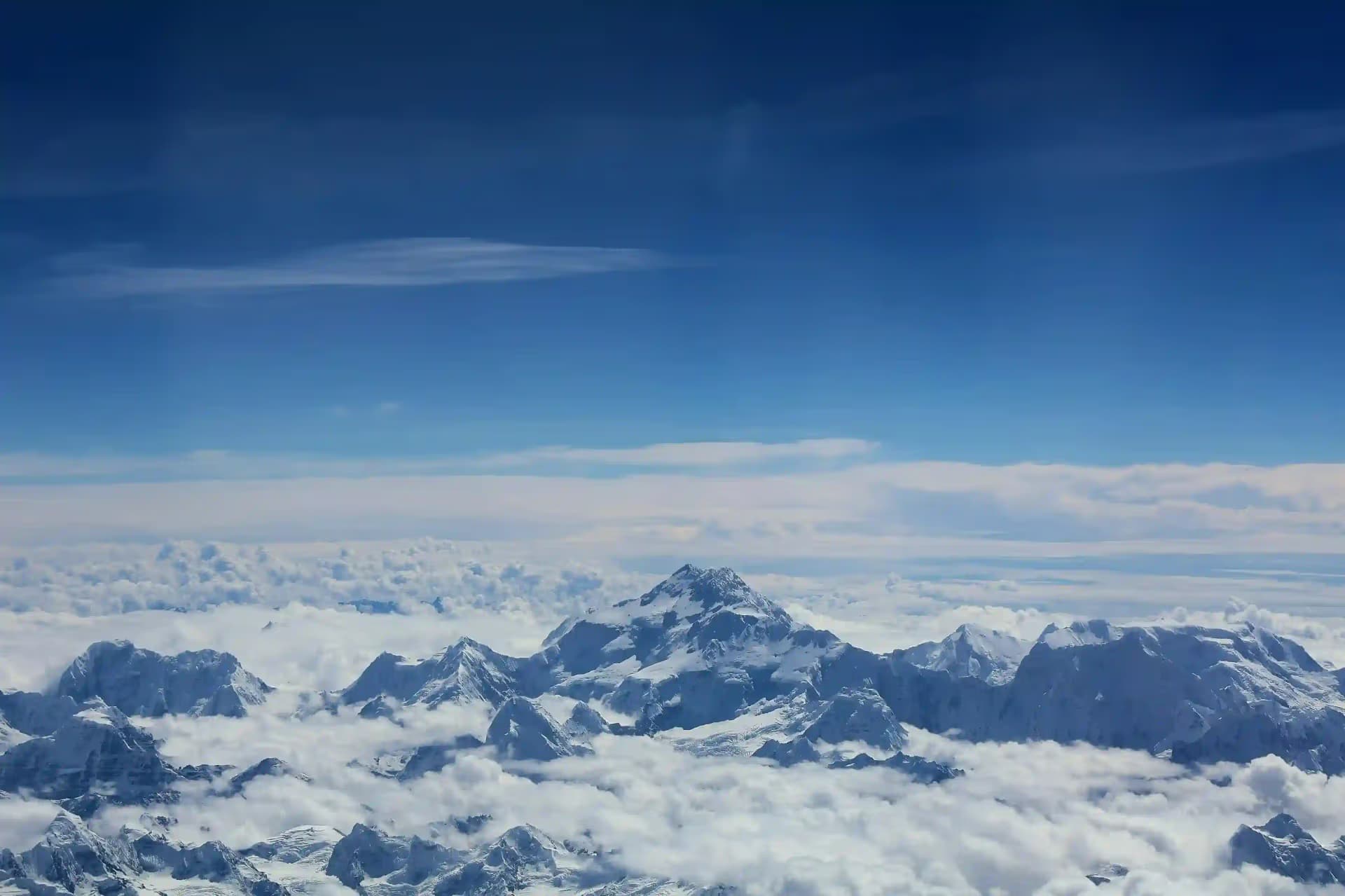
The top of Mount Everest isn’t a wide, dramatic peak as people imagine in posters. It’s sharper, tighter, and just wide enough for maybe 10-15 people if everyone squeezes in carefully.
On a clear day, the world opens up in a strange way from Mount Everest's top. The sky up there doesn’t look blue in the normal sense either.
It shifts into this deep, almost ink-like indigo because there’s barely any atmosphere left above you. It feels less like standing on a mountain and more like standing on the edge of the sky
At that altitude 8,848.86 meters, the body doesn’t really cooperate anymore. Oxygen is roughly 33% of what it is at sea level and even with bottled oxygen, climbers suffer.
Breathing takes effort you can’t imagine from here. Thoughts slow down. Movements lose sharpness. People standing on the top of Mount Everest often describe it as being half-awake in a dream you chose to enter.
The cold doesn’t sting immediately; instead, it seeps in quietly like it’s been there all along.
Time on the top of Mount Everest doesn’t stretch long. Most climbers stay somewhere between 5 and 15 minutes. Not because they want to rush it, but because the mountain doesn’t really allow lingering.
Photos, a quick satellite call if the signal works, maybe a moment just standing still trying to register what “being there” actually means… and then the shift happens. The mind starts reminding you that down is harder than up. That urgency becomes louder than celebration.
On the first ascent in 1953, Tenzing Norgay placed chocolate and biscuits into the snow as a Buddhist offering, while Edmund Hillary reportedly left a small cross, tiny human gestures in a place that doesn’t care much for symbolism.
By 2026, the top of Mount Everest will have changed in subtle but important ways. The famous Hillary Step that near-vertical rock barrier just below the summit, partially collapsed in 2017, reshaping the final push compared to what Hillary and Tenzing climbed.
Solar-powered weather stations now sit close to the summit, quietly collecting data in conditions that would shut down most machines instantly. And during peak May seasons, the summit isn’t always empty or peaceful anymore.
Sometimes there’s a line forming near the final ridge, with climbers waiting up to 45 minutes just to step onto the highest point on Earth. It’s still remote, still extreme. But it’s no longer solitary.
Mount Everest Height Facts at a Glance
| Fact | Detail |
|---|---|
| Official Height (2020 survey) | 8,848.86 m / 29,031.7 ft confirmed by2020 joint China-Nepal survey |
| Previous Official Height (1955) | 8,848 m / 29,029 ft |
| Mount Everest Summit Elevation | 8,848.86 metres above sea level |
| Mountain Range | Himalayas Mahalangur Himal sub-range |
| Countries | Nepal (south face) and Tibet/China (north face) |
| First Official Measurement | 1856, Great Trigonometric Survey of India |
| Distance from Earth's Centre | ~6,382 km (not the furthest Chimborazo is) |
| Height Above the Death Zone | 848.86 m above the 8,000m Death Zone threshold |
| Atmospheric Oxygen at Summit | Approximately 33% of sea-level oxygen |
| Annual Uplift from Tectonic Movement | ~4mm per year (partially offset by erosion) |
How Many People Have Summited Mount Everest? Complete Summit Records Till 2026
Talking of 2026. More than 7,000 foreign individuals have reached the summit of Mount Everest. And 13,752 total summit ascents are recorded. The data is based on the Himalayan Database, which is the most trusted source tracking every climb, success, and loss on this mountain.
That number sounds huge at first. But when you realize it had spread across decades, across countries, across thousands of failed attempts that never make headlines, it isn’t that big. Still today, Everest isn’t crowded in the way people imagine, it’s just more accessible than it used to be.
It didn’t start like this. On May 29, 1953, Tenzing Norgay and Edmund Hillary stood on the summit for the first time and for decades after that Everest remained rare. Fewer than 500 people reached the top in the first 40 years.
Then the 1990s changed everything. Commercial expeditions came in, logistics improved, fixed ropes became standard, and suddenly, Everest wasn’t just for elite climbers. It became something ambitious, difficult, but possible.
By 2026, 1008 people had summited in a single season (including foreign climbers and Nepalese Sherpa). Numbers climbed fast, permits increased, and the mountain started seeing more consistent traffic, especially on the Nepal side through permits issued by Nepal's Department of Tourism.
Now here’s the part people don’t always picture clearly. In 2026 alone, Nepal issued 494 climbing permits for Everest. That doesn’t mean 494 people on the mountain; it means that number multiplied by guides, Sherpas, and support teams.
This potentially pushes the total presence above 1,000 people during a single summit window. And that window can sometimes be just a few days long when weather aligns.
So yes, there are moments where climbers queue near the final ridge, not because Everest is “overrun,” but because timing compresses everyone into the same narrow shot at the summit. It’s less chaos, more… bottlenecked ambition.
If you are ready to experience the Everest Himalayas beyond the stories and statistics, Everest Thrill offers professionally guided Everest Base Camp treks and Himalayan expeditions led by experienced Sherpa teams, designed to help you explore the world’s highest mountain safely, responsibly, and with real mountain expertise.
Mount Everest Summit Statistics
- First Summit (May 29, 1953): Tenzing Norgay and Edmund Hillary reached the top at 11:30 am. The news landed in London almost perfectly timed with Queen Elizabeth II’s coronation. It was very neatly framed as a symbolic gift to the crown. History loves that kind of coincidence.
- Most Summits by One Person: Kami Rita Sherpa has climbed Everest 32 times as of 2026. That’s not just a statistic. It’s repetition at an extreme level. Up, down again and again, while most climbers spend years chasing a single summit. This is a different scale of commitment entirely.
- First Woman to Summit (May 16, 1975): Junko Tabei of Japan reached the summit via the southeast ridge. She later completed the Seven Summits, but Everest was where she broke through the barrier that had quietly held for too long.
- Youngest Person to Summit: Jordan Romero on May 22, 2010, stood on top at just 13 years and 10 months. The climb was carried out from North side route, Tibet side. Though it is still debated in some circles, it is officially recognized.
- Oldest Person to Summit (May 23, 2023): Arthur Muir reached the summit at 72 years and 332 days. Age doesn’t disqualify you here. It just changes the margin for error.
- First Summit Without Oxygen (May 8, 1978): Reinhold Messner and Peter Habeler proved something many thought unrealistic by climbing Everest without bottled oxygen. The assumption before that? Humanly impossible.
- First Solo Summit (August 20, 1980): Reinhold Messner again. Alone this time. New route. Monsoon season. No oxygen. Even now, it reads less like a record and more like something out of touch.
- Most Summits in a Single Season: The 2023 spring season saw over 600 successful summits, confirmed by Nepal’s Department of Tourism. That’s the current single-season peak. It was too crowded but efficient as well.
- First Blind Person to Summit (May 25, 2001): Erik Weihenmayer reached the top with a guided team. Not only that, he later completed all Seven Summits. That detail alone shifts how people think about limitation.
- First Paraglide from the Summit September 26, 1988: Jean-Marc Boivin launched from the summit and landed at Base Camp in roughly 11 minutes. Paragliding from the summit is very rare and extreme summit record. Only three teams (5 person in total) have achieved that.
- Single-Day Ascents May 20, 2026: A record 274 climbers stood on top of the world in a single day.
How Many People Have Died on Everest?
As of 2026, over 340 people have died on Mount Everest. This is according to the record from the Himalayan Database for fatality statistics. That’s roughly 1-2% of all summit attempts.
The causes aren’t mysterious. Avalanches, falls, high-altitude illnesses like High Altitude Cerebral Edema and High Altitude Pulmonary Edema, and simple exposure to extreme cold are the straightforward reasons on paper.
What’s harder to process is that over 200 bodies still remain on the mountain. Not because people don’t care, but because bringing them down from that altitude is often more dangerous than leaving them there. It’s not something climbers ignore. It’s something they quietly accept before they even begin the climb.
The Death Zone: What Happens to the Human Body Above 8,000 Metres
Above 8,000 metres, you enter what climbers bluntly call the Death Zone and it’s not dramatic naming, it’s just accurate. The body stops adapting up there. No more acclimatization, no slow
adjustment, just a steady, quiet breakdown. At the top of Mount Everest, air pressure drops to about a third of what you’re used to at sea level, which means every breath gives you roughly 33% of the oxygen your body expects. Imagine trying to function, think, move, and decide while your system is running on that kind of deficit. It’s not sustainable. It was never meant to be.
Things start slipping in ways that aren’t always obvious at first. The brain, starved of oxygen, doesn’t fail all at once, but it fades. Judgment gets weird. Simple decisions take too long. That’s where Altitude Sickness can escalate into more serious forms like HACE or HAPE. Meanwhile, the body tries to compensate by thickening the blood with more red cells and more oxygen transport, but that raises the risk of strokes and clots.
Temperature doesn’t help either. On a “good” spring day, you’re looking at around -20°C near the summit. Winter? Drop that to -60°C. Add wind speeds pushing past 200 km/h, and suddenly, even standing still becomes a fight.
So climbers don’t stay there. They can’t. No one sleeps at the summit, no one camps comfortably above 8,000 metres. Summit pushes are designed as single, continuous efforts ranging from 8 to 16 hours of climbing straight through from high camp to the top and back down.
And here’s the uncomfortable truth: most deaths don’t happen on the way up. They happen on the descent, when the body is drained, oxygen is low, and focus starts slipping at the worst possible time.
Then there’s the weather window small, unpredictable, and shared by everyone on the mountain. When it opens, climbers move. All of them. Which is how you get bottlenecks in the Death Zone, where standing still too long isn’t just frustrating, it’s dangerous.
Speed Records on Everest: The Fastest Climbs in History
The fastest time to climb Everest from Base Camp to the summit is 9 hours, 55 minutes, and 43 seconds, set by Tyler C. Andrews in 2026 May 28. Even reading that feels a bit unreal if you’ve ever walked above 5,000 meters and felt your lungs arguing back.
Under eleven hours from Base Camp to the top, there are no slow rotations and no drawn-out push, just a straight, relentless climb through terrain that usually breaks people over weeks.
Now stack that against a “normal” Everest climb, and the contrast hits harder. A standard guided summit push from Camp 4 to the top takes somewhere between 12 to 18 hours on its own.
That’s just the final stretch. The full expedition? You’re looking at 40 to 60 days, sometimes more, because the body needs time to adjust, climb high, drop low, repeat… again and again.
Speed climbers don’t follow that script the same way. They move lighter, faster, often with a completely different risk profile. It’s less about endurance over weeks and more about pushing the body right to the edge in a very short window.
Everest Speed Records at a Glance
| Record | Person | Details | Year |
|---|---|---|---|
| Fastest ascent - Base Camp to Summit | Tyler C. Andrews (American ) | 9 hrs 55 min 43 sec | 2026 |
| Fastest ascent - Advance Base Camp, no oxygen | Kilian Jornet (Spain) | ~26 hrs from ABC, north side | 2017 |
| Fastest round trip (Base Camp to Summit and back) | Pemba Dorje Sherpa (Nepal) | 8 hrs 10 min (reported record) | 2004 |
| Fastest ascent from north side | Hans Kammerlander (Italy) | 16 hrs 45 min from north base camp | 1996 |
| Fastest female ascent | Phunjo Jhangmu Lama (Nepal) | Under 14 hours - record to be verified | 2023 |
Everest Weather Extremes: The Coldest, Windiest, Most Hostile Point on Earth
Up on the summit of Mount Everest, temperature isn’t something that “changes with seasons” in a comforting way. It just shifts between brutal and worse.
In the May climbing window, which is considered the most stable time of year, you’re still looking at around -20°C (-4°F) near the top. That’s a good day.
Come winter, it drops to -60°C (-76°F). This much cold is enough to freeze exposed skin. And here’s the part people don’t always realize: the temperature at the top of Everest is never above freezing, not in spring, not in summer, not ever. The sun might be blazing, the sky may be clear, but the air? Still biting through everything.
Then there’s the wind. This is where Everest really shows its teeth. During winter, the jet stream sits directly over the summit, pushing winds well past 200 km/h.
Imagine the speed. It is strong enough to knock a climber off balance, rip tents apart, and make movement almost impossible. The only reason people climb in spring is that, for a short window, the jet stream shifts north. Though not gone, just moved enough to create a narrow band of relatively calmer conditions.
And history has already shown what happens when timing slips. The 1996 Everest disaster made it one of the deadliest seasons ever. This time, mountaineering history witnessed 15 climbers lose their lives. This was largely because of a storm that hit faster and harder than expected.
Too many people, too slow to descend, and suddenly the weather window slammed shut. That event changed things. Not overnight, but it forced the industry to take forecasting more seriously, to tighten logistics, to rethink how summit days are managed.
If you’ve read Into Thin Air, you already know how chaotic it got up there. If you haven’t… It’s worth it, not for drama but for understanding how thin the margin really is.
The Human Firsts: 15 Records That Changed Everest History
- First Summit (May 29, 1953): Tenzing Norgay (Nepal) and Edmund Hillary (New Zealand). They reached the top late morning, quiet, almost anticlimactic in the moment, but the news hit London on the day of Queen Elizabeth II’s coronation, and suddenly it became historic. Hillary later shrugged it off in his own way: “We knocked the bastard off.”
- First Summit Without Oxygen (May 8, 1978): Reinhold Messner (Italy) and Peter Habeler (Austria). At the time, experts were convinced this would kill them. Messner described it as “a single tiny gasping lung.” Not heroic but more like barely surviving.
- First Solo Ascent (August 20, 1980): Reinhold Messner. He conquered the record for the first solo ascent alone on the north face, no oxygen, during the monsoon. Three days above 8,000m with no backup. When asked why, his answer was blunt: mountains aren’t fair, they’re just dangerous.
- First Woman to Summit (May 16, 1975): Junko Tabei (Japan). Twelve days before the summit, an avalanche buried her camp. She was pulled out unconscious. Most would’ve turned around but she surprised the world not only by fighting back, but also by creating a world record.
- First American to Summit (May 1, 1963): James Whittaker (USA). He summited via the southeast ridge and left an American flag at the summit, which later is said to have ended up in the hands of President Kennedy.
- First Summit via North Face (May 25, 1960): Wang Fuzhou, Gonpo and Qu Yinhua (China), climbing from Tibet were the first to ascend Mt. Everest’s peak from the Chinese side. For years, people doubted it happened at all because the team could not publish the summit photos.
- First to Summit Twice (October 1979): Reinhold Messner. Two summits, two different styles one without oxygen. Not repetition… evolution.
- First Person with Prosthetic Legs to Summit (May 15, 2006): Mark Inglis (New Zealand). Mark Inglis lost both legs decades earlier and came back on prosthetics. Despite, his return was so strong that it became an inspiration in history.
- First Blind Person to Summit (May 25, 2001): Erik Weihenmayer (USA). Guided by a team of 18, Erik Weihenmayer succeeded in the impossible. He described the summit not in visuals but in sensations the wind, the cold, the emptiness.
- First to Ski from the Summit (October 7, 2000): Davorin Karničar (Slovenia). Skied from the summit to Base Camp. No breaks. No shortcuts. He took just one continuous descent.
- First Paraglide from the Summit (September 26, 1988): Jean-Marc Boivin (France). He jumped off the top and landed at Base Camp in about 11 minutes. Climbers spend weeks going up he was down before most people would even start their summit push.
- First Woman to Summit Without Oxygen (October 1988): Lydia Bradey (New Zealand). Her own teammates doubted her summit at first. It took time before it was officially accepted.
- Youngest Person to Summit (May 22, 2010): Jordan Romero (USA). Romero climbed from the north side with family when he was just 13 years old.
- Oldest Person to Summit (May 23, 2023): Arthur Muir (USA). At age 72 years and 332 days, the guy proved that age doesn’t stop people here it just changes how hard the fight is.
- First to Live-Broadcast from the Summit (May 2012): The summit went digital. A live HD broadcast from the top of Mount Everest was carried out, too. It was something that would’ve sounded ridiculous in Hillary’s time.
The Mallory Mystery: Did Anyone Reach the Top of Mount Everest Before 1953?
On June 8, 1924, George Mallory and Andrew Irvine vanished high on Mount Everest. They were last spotted “going strong for the top” through a brief break somewhere around 800 metres below the summit. And that’s where the story freezes. No confirmed summit. No confirmed turnaround.
Just a question that’s been hanging in the thin air ever since: did they reach the top nearly three decades before Hillary and Tenzing?
There are reasons people believe they might have. Mallory wasn’t just strong; he was relentless, the kind of climber who leaned into risk without dressing it up. That morning, conditions were reportedly clear. The timing? It lined up with what could have been a summit push.
Then in 1999, an expedition found Mallory’s body at 8,160 metres on the north face, shockingly preserved. One detail stuck: his sunglasses were in his pocket. Climbers don’t take those off in daylight at that altitude. Which raises the quiet possibility… was he descending in fading light when he fell?
But then the doubts creep back in. The biggest missing piece is Irvine’s camera never found. If it’s out there, if the film somehow survived, it could settle everything in a single frame.
And then there’s the second step, that steep 27-meter rock barrier around 8,610 meters. Today, climbers use fixed ladders and modern gear to get over it. In 1924? Wool clothing, basic boots, and primitive equipment. Most historians look at that and shake their heads. Too technical. Too exposed. Too early.
So where does that leave it? Irvine’s body hasn’t been found. The camera hasn’t surfaced. No final proof, no clean answer. Just this strange, unresolved edge in Everest’s history, one where the line between “first” and “almost” hasn’t been drawn yet. And maybe that’s why it still pulls people in.
Some questions don’t fade. They just wait.
Everest’s Geography and Geology: The Science Behind the World’s Highest Peak
The story of Mount Everest starts way before climbing routes, base camps, or even human history.
The entire Himalayan range, including what we now call the Everest Himalayas, began forming roughly 50 million years ago when the Indian subcontinent slammed into the Eurasian plate. It was a slow, relentless collision that crumpled the crust upward like a massive geological wrinkle.
Before that collision, this whole region sat under an ancient ocean called the Tethys Sea. That’s why, even today, marine fossils like coral fragments, shells, and tiny traces of sea life have been discovered high up near Everest’s slopes.
It’s a strange thought: you’re standing at nearly 8,850 meters and still brushing against evidence of an ocean floor. Parts of this broader landscape also fall under the protection of Sagarmatha National Park.
Geographically, Everest sits deep within the Mahalangur Himal sub-range of the Everest Himalayas, straddling the border between Nepal and the Tibet Autonomous Region of China.
On the Nepal side, it’s known as “Sagarmatha,” which translates loosely to “goddess of the sky”. The name feels too fitting once you’ve seen the peak cutting through cloud layers.
On the Tibetan side, it’s called “Chomolungma,” meaning “mother of the universe.” The English name “Everest” comes from Sir George Everest.
He was a British surveyor who never actually saw the mountain in person and, interestingly enough, wasn’t even fond of the idea of naming it after him. Still, the name stuck, as most colonial labels do in maps and textbooks.
Structurally, Everest isn’t just one uniform pyramid. It has distinct faces and ridges that define how people interact with it. The southeast ridge, rising from Nepal, is the most commonly used route and is famously linked with the Hillary Step approach (the standard “Nepal route”).
On the opposite side lies the northeast ridge in Tibet. It serves as the primary “Tibet route” and is known for being colder, windier, and more exposed for longer stretches.
Then there’s the Kangshung Face on the east side. This side is steep, remote. and brutally unforgiving. And as expected, it is rarely climbed because it feels less like a route and more like a wall of ice and rock that just happens to exist at extreme altitude.
Everest’s Environmental Records: Numbers That Should Give Us Pause
The reality of Mount Everest isn’t just altitude and achievement; it’s also accumulation. Since climbing activity began in a serious way, the mountain has quietly collected an estimated 50+ tons of waste.
This includes empty oxygen cylinders, torn tent fragments, food packaging, rope, and even human waste frozen into layers of ice.
At extreme altitude, nothing really disappears or decomposes. It just stays there, preserved. To control this, Nepal introduced a deposit-based system where climbers must bring back at least 8kg of waste per person or risk losing their refundable deposit.
It seems a simple rule on paper, but on the mountain, when the weather turns and oxygen drops, even 8kg can feel like a burden.
But the bigger story is happening beneath your boots. The Everest Himalayas are changing fast and the Khumbu Glacier is one of the clearest signals of that shift. It has retreated roughly 5km since the 1950s and lost an estimated 45% of its total volume.
That’s not a slow, distant change; it’s measurable within a human lifetime. A 2023 study also found that the glacier is thinning at its fastest recorded rate. This is reshaping climbing routes, crevasse patterns, and even base camp safety. You can explore broader climate data and recent studies on glacial retreat through IPCC research.
Still, it’s not all lost without a response. Over the past decade, Nepal and expedition groups have started treating Everest like a fragile system rather than an endless resource. Mandatory waste return policies, seasonal clean-up expeditions, and organizations like Eco Everest Expedition have together removed over 100 tons of debris since 2008.
It’s not perfect, and it never will be on a mountain this extreme, but the direction has shifted. Operators like Everest Thrill are also increasingly embedding responsible trekking practices into our expeditions.
Understanding that Everest isn’t just something to climb, it’s something to protect while you still can, is the best possible awareness any climber or trekker can have.
More Facts About Mount Everest Worth Knowing
This is the final stretch of the full 55-record structure.
Facts About Everest’s Physical Structure
The Hillary Step used to be an intimidating final choke point just below the summit. Around 2017, it partially collapsed. Climbers still argue about how much it “changed” things, but emotionally? That last section still messes with people.
The Khumbu Icefall is basically a living beast pretending to be a route. It shifts. Sometimes casually and sometimes violently, up to about a meter a day.
You can imagine walking through a maze that redraws itself overnight. That’s why ladders get reset constantly, like someone trying to patch a road while it’s melting under their hands.
As mentioned above, Summit geography also isn’t just one point. There’s the South Summit, the Main Summit and the North Summit.
Most people only talk about the top, but the ridge between them is where exhaustion starts making decisions for you.
Facts About Climbing Everest
Climbing Everest isn’t cheap. A standard permit alone runs around $15,000 per person (as per 2026 update). Add logistics, guides, oxygen, food, Sherpa support, and instantaneously it's enough to empty one's card.
The route itself is almost like a vertical city. Base Camp, Camp 1, Camp 2, Camp 3, Camp 4 at the South Col. Each one sits in a different physiological nightmare zone. You don’t just “climb up.” You live in stages of thin air, slowly borrowing time from your own body.
Acclimatization takes weeks, usually 6-8. People rotate up and down like they’re pacing themselves in a fight. Rush it, and the mountain doesn’t negotiate. It just shuts your body down quietly.
On Summit day. The human machine goes weird. Around 10,000 calories can be burned off, but appetite basically disappears somewhere above 7,000m. Food becomes a task, not fuel. You eat because you must, not because you want to.
Facts About the Khumbu Region and Sherpa Culture
The Sherpa connection to this region isn’t recent tourism history. It’s centuries deep. Around 500 years of settlement in the Khumbu valley, with roots tracing back to Tibet. Over time, life here has adapted in ways science still tries to fully explain.
Tengboche Monastery sits at 3,867m and honestly, it feels like the mountains pause around it. It’s been destroyed and rebuilt more than once by an earthquake in 1934 and a fire in 1989. But it still stands like the region’s emotional anchor. If you hit it during the Mani Rimdu festival, the whole valley shifts mood. The quiet turns ceremonial.
Sagarmatha National Park, which has been listed in the UNESCO World Heritage Site since 1979, isn’t just protection on paper. It’s a living zone covering over 1,100 square km of the Everest Himalayas. Snow leopards, red pandas, and Himalayan tahr. Things survive in conditions that feel like they shouldn’t support much at all.
Even something as simple as Lukla has deeper roots. The name literally refers to goats and sheep, long before it became famous for one of the world’s most dramatic airports. Hard to imagine now, with planes dropping into that short runway like controlled chaos.
And the 1953 Everest expedition, the first one. Over 350 porters and around 20 Sherpa guides made it possible. Hillary and Tenzing may have stood on the summit, but they were guided, carried, and crowned in the mountain by a whole system of people behind them.
Facts About Recent Records and Modern Everest
The 2015 earthquake still sits heavily in Everest's history. April 25, Base Camp, avalanche triggered by a 7.8 quake. The incident caused 22 lives lost in a single collapse of earth and ice. It changed how people think about safety at the very bottom of the climb.
Speed records are still wild in comparison to everything else. Lhakpa Gelu Sherpa’s 10 hours 56 minutes from Base Camp to summit (2003) remains unbeaten on the standard route. Two decades later, that number still feels unreal.
Till 2026, more than 7,000 foreign climbers from over 100 countries will have reached the top of Mount Everest. It’s no longer a niche achievement. It’s global, tracked, archived, and studied through the Himalayan Database like a living dataset of ambition.
Winter Everest? Still extreme, though not untouched. The first successful winter summit was conducted by Krzysztof Wielicki and Leszek Cichy on 17 February 1980. Though among any other 8,000m peak, Everest presents you the toughest conditions to climb in winter. Like it has its own rulebook, nobody can override.
Can I Trek to Everest Base Camp and See the Mountain Myself?
Short answer? Yeah.
And most people who “experience Everest” never actually climb it. The Everest Base Camp Trek is that route. No ropes, no ice axes, no technical climbing drama. Just a long, steady push up to 5,364m where the air gets thin and your thoughts get oddly simple.
You’re moving through the Everest Himalayas like you’ve been dropped inside a geography lesson that forgot to be polite about scale.
Sherpa villages clinging to slopes, prayer flags snapping in wind that never really stops, suspension bridges doing their nervous little shake over glacial rivers. Then Tengboche shows up with its quiet, almost theatrical ambience.
Eventually, the timeless beauty of Khumbu Glacier and then Everest itself. Not in theory. In front of you.
From Lukla, it’s usually 12-14 days of walking, depending on how your body reacts to altitude and how stubborn you are about pacing.
No mountaineering background needed. Just legs, lungs and the willingness to slow down when your body is clearly negotiating with altitude.
Spring and autumn are the sweet spots with clear skies, sharper views, less chaos in the weather. Winter feels harsher, summer gets moody with monsoon clouds.
If you want a deeper sense of responsible trekking ethics in Himalayan regions, there’s also structured guidance available through the International Porter Protection Group (IPPG).
And here’s where it gets really practical. If this is even slightly pulling you, don’t leave it as a vague idea sitting in your browser tabs.
Check the Everest Base Camp Trek packages and see what the actual route, logistics, and support look like. Then observe the EBC cost breakdown guide (because Everest has a funny way of turning “simple plans” into layered budgets).
And finally, also monitor the training guide. This is the one people ignore until their knees start negotiating mid-trial.
Frequently Asked (Searched) Questions
How Many feet is Mount Everest?
Mount Everest is 29,031.7 feet (8,848.86 meters). Data is confirmed by the 2020 joint China–Nepal survey. The measurement replaced the earlier official height of 29,029 feet that had been used since 1955.
What is the summit elevation of Mount Everest?
The summit elevation of Mount Everest is 8,848.86 meters (29,031.7 feet) above sea level. It is a globally accepted standard height, officially confirmed in December 2020.
How many people have summited Mount Everest?
Till 2026, over 7,000 individuals have reached the summit of Mount Everest. Total ascents exceed 13,000 if repeated climbs are included. The data source is the Himalayan Database.
What does the top of Mount Everest look like?
The top of Mount Everest is a tight, snow-covered ridge. It is roughly the size of a kitchen table with just enough space for about 10-15 climbers at once. On a clear day, the entire Himalayas spreads beneath, and the sky turns a deep, almost surreal indigo.
How many people have died climbing Everest?
As of 2026, over 340 people have died on Mount Everest. Most fatalities come from avalanches, falls, altitude sickness, and exposure. More than 200 bodies still remain on the mountain, frozen in place.
What is the fastest time to climb Everest?
The fastest ascent from South Base Camp to the summit of Mount Everest is 9 hours, 55 minutes, and 43 seconds, set by Tyler C. Andrews in 2026 May 28.
What is the Everest Himalayas region?
The Everest Himalayas refers specifically to the Mahalangur Himal, a sub-range of the vast Himalayas on the border of Nepal and China (Tibet). The full Himalayan system stretches roughly 2,400 km across five countries and holds all 14 of the world’s 8,000+meter peaks. At its apex sits Mount Everest.
Has anyone climbed Everest in winter?
Krzysztof Wielicki and Leszek Cichy completed the first successful winter summit on February 17, 1980. Though Everest still has the most difficult winter climbing conditions than any other 8,000-meter summit.
Who has climbed Everest the most times?
Kami Rita Sherpa, with 32 successful ascents, is currently the record holder for summiting Mount Everest the most times. His record reflects decades of sustained experience on the mountain rather than short-term achievement.
What is the best time of year to see Mount Everest?
The Best time to see Mount Everest is in September-November and March-May for sure. September-November and March-May provide stable trekking and climbing conditions. At these times, the visibility is excellent.
About Author
Amir Adhikari is the Founder and Trip Curator of Everest Thrill Trek and Expedition. With 10+ years of experience in Nepal’s competitive tourism sector, he is a recognized expert in designing safe, personalized, and high-thrill Himalayan itineraries. His dedication to responsible travel and creating authentic experiences has positioned Everest Thrill as a leading specialist for Everest, Annapurna, and off-the-beaten-path adventures.