Lukla Airport | Location, Elevation and Weather
Table of Contents
- What Is Lukla Airport And Why Does Every Everest Trek Start Here?
- Where Is Lukla Airport? Location and Map
- A Brief History: From Hillary’s Farmland to the World’s Most Famous Airstrip
- Key Facts and Specifications of Lukla Airport
- Why Is Lukla Airport Considered So Dangerous?
- A History of Accidents at Lukla Airport And What Changed
- Lukla Airport Flight Experience: What to Actually Expect
- Tips for Nervous Flyers on the Lukla Route
- The Lukla Airport Viewpoint: Watching the World’s Most Thrilling Landings
- Lukla Airport Weather: What to Expect Month by Month
- Seasonal Breakdown: Lukla Airport Weather
- Flying from Kathmandu or Ramechhap? What Every Trekker Must Know in 2026
- Kathmandu vs. Ramechhap: Key Differences for Trekkers
- How to Book a Lukla Flight: Including If You're Travelling Independently
- What Is the Baggage Allowance on Lukla Flights?
- Which Airlines Currently Fly to Lukla? (2026)
- Delay and Cancellation Planning: How to Protect Your Trek?
- What to Do If Your Lukla Flight Is Cancelled
- Arriving at Lukla: Your First Hour in the Everest Region
- Altitude on Arrival: What Your Body Will Feel at 2,845m
- The Lukla Airport Viewpoint: Where to Watch the Landings
- Trekking Routes That Begin at Lukla Airport
- Everest Base Camp Trek
- Everest Base Camp Trek with Helicopter Return
- Gokyo Lake Trek
- Everest Three Passes Trek
- Mera Peak Climbing
- Frequently Asked Questions
If you’re about to fly into Lukla via the only option of Lukla Airport, you are probably getting a mix of feelings of excitement and nervousness. There’s always this moment before Lukla. So, obviously, that’s normal. This small mountain airstrip is the main entry point to the Everest region and almost every trek to Everest Base Camp begins with this flight.
In the sections ahead, you’ll get a clear picture of what the Lukla airport actually is, where it sits in Nepal’s Khumbu region, what the flight feels like from takeoff to landing, how weather controls everything, how delays really play out on the ground and what has changed in 2026 with Ramechhap diversions affecting most peak-season departures.
What Is Lukla Airport And Why Does Every Everest Trek Start Here?
Lukla Airport or officially Tenzing-Hillary Airport (LUA / VNLK): sits in the mountains of Solukhumbu District, Koshi Province, northeastern Nepal. Actually, it's a small place on the map but a big deal in real life. If Everest trekking had a “front door,” this would be it. Slightly crooked, always busy, a bit weather-sensitive… but absolutely central.
Most people first hear about it when they book the Everest Base Camp Trek, then only later realize: oh, this isn’t optional. The airport connects directly to the Everest region and surrounding valleys, places like Namche, Tengboche, Dingboche.
And there is no road that replaces this route. Not even close. Without Lukla, you’re looking at an extra 5–7 days of walking just to reach where most treks begin. That’s not a small detour, that’s a completely different expedition. So yeah, this little strip of asphalt basically saves time, energy and honestly, logistics that would otherwise turn the Everest region into a much harder puzzle.
Lukla Airport also does something less talked about. It keeps life moving here. Cargo flights bring food, gear, medicine. Helicopters come and go for emergencies. Local Sherpa communities rely on it in ways trekkers often don’t notice until they’re already sitting in Lukla tea houses watching the airport run.
After the airport came into operation, trekking-related fatalities in the region dropped significantly, roughly around the 50% range over time. The reason isn’t magic. It’s just speed. When altitude turns serious, getting someone out quickly changes everything. So yeah, Lukla isn’t just a start point. It’s more like a hinge and everything in the Everest region swings from here.
Where Is Lukla Airport? Location and Map
Lukla Airport is located in Nepal, specifically in the small mountain town of Lukla, inside Khumbu Pasanglhamu Rural Municipality, Solukhumbu District, Koshi Province, northeastern Nepal. By air, it's roughly 136 km northeast of Kathmandu.
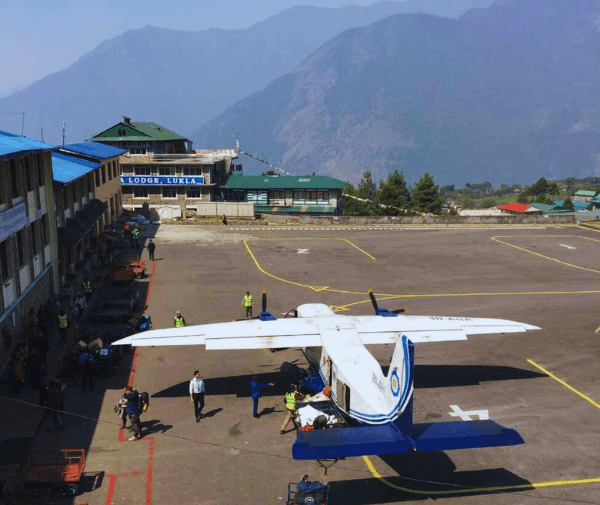
It also lies close to the boundary of Sagarmatha National Park, a UNESCO World Heritage Site. Peaks start stacking up around you pretty quickly here and not as distant scenery, but as actual walls in the landscape.
A Brief History: From Hillary’s Farmland to the World’s Most Famous Airstrip
This place has a story that doesn’t feel very “airport-like” at all.
Back in 1964, Sir Edmund Hillary was involved in setting up the airstrip mainly to support schools and expedition access in the Khumbu region. But the interesting part is how it was actually built. No heavy machinery rolling in. No fancy construction fleet. Just local Sherpa communities clearing and leveling land by hand because that’s all that was possible up there.
Originally, the runway wasn’t even paved. Just a rough strip, functional in the most basic sense. It stayed like that for decades until it finally got paved in 2001, which made operations a bit more stable, just a bit more.
Then in 2008, it was renamed Tenzing-Hillary Airport, honoring Tenzing Norgay and Edmund Hillary. As you might know, they were the first confirmed Everest summiteers from 1953. Though most people still just say “Lukla.” Shorter. Easier. Somehow more fitting.
Even the word “Lukla” itself has roots in Sherpa language, often translated loosely as “place of many goats and sheep.” Which feels oddly peaceful for a place that now handles some of the most adrenaline-filled trekking journeys on Earth.
Key Facts and Specifications of Lukla Airport
Lukla Airport looks simple at first glance, but the specs tell a very different story. These numbers are basically the reason it behaves unlike any other airport on Earth.
That 11.7% slope isn’t some design compromise or mistake someone forgot to fix. It’s intentional. Kind of clever, actually. The runway is basically tilted uphill so aircraft can bleed off speed faster when landing and then use that same slope to help gain momentum on takeoff. In a place where you don’t have much room to correct later, that slope does a lot of quiet heavy lifting.
| Specification | Detail |
|---|---|
| Official Name | Tenzing-Hillary Airport |
| Also Known As | Lukla Airport |
| IATA Code | LUA |
| ICAO Code | VNLK |
| Country | Nepal |
| District | Solukhumbu District, Koshi Province |
| Elevation | 2,845 m (9,334 ft) above sea level |
| Runway Length | 527 m (1,729 ft) |
| Runway Width | 30 m (98 ft) |
| Runway Gradient | 11.7% uphill slope |
| Runway Surface | Paved asphalt (paved in 2001) |
| Aircraft Types | Twin Otter, Dornier 228, Pilatus PC-6, helicopters |
| Operating Hours | Approx. 6:00 am - 3:00 pm (weather dependent) |
| Flight Type | VFR (Visual Flight Rules) only |
| Annual Trekkers Served | ~30,000+ |
And the VFR-only rule is the other big one. No radar guiding planes in. No instrument landing system to rely on. Just visibility, timing and pilots who know this route like muscle memory. If the weather closes in, everything stops. Simple as that.
It’s one of those places where the math looks tight on paper and somehow still works in real life.
Why Is Lukla Airport Considered So Dangerous?
People hear "Lukla" and immediately jump to the word dangerous, partly because of reputation, partly because of YouTube clips, and partly because the internet loves dramatic labels. The reality is a bit more technical and less cinematic.
There are four real factors that stack up here. First, the runway is extremely short, and there's basically no room for correction. Meaning, if the landing approach is misjudged, there isn't a long strip to recover or "try again." Second, the altitude sits at 2,845 meters, which means thinner air and reduced lift performance for aircraft. Engines and wings don't behave the same way they do at sea level. Everything becomes more sensitive. Then there's no radar coverage. No instrument landing system is guiding pilots in.
Flights operate under VFR, which means pilots rely on direct visibility and timing. If clouds roll in or visibility drops, operations simply stop. And finally, the geography itself. A narrow valley carved between steep Himalayan terrain, with a single approach path in and out. There's no wide circle and no easy reroute.
Lukla's reputation as one of the "most dangerous airports" and specifically why people ask why Lukla is the most dangerous airport was largely cemented after the History Channel's 2010 "Most Extreme Airports" feature. That label stuck, and honestly, it never really left the public imagination.
But the operational reality today is more controlled than the reputation suggests. Civil Aviation Authority of Nepal (CAAN) has some of the strictest requirements anywhere for pilots flying this route. These include 100+ STOL missions, a minimum of one year operating in Nepal's mountain conditions, and 10 supervised Lukla approaches with a certified instructor before solo clearance is granted. Tens of thousands of trekkers complete this flight without incident every year.
A History of Accidents at Lukla Airport And What Changed
Lukla’s operational history does include a few serious incidents, but they’re spaced out across decades rather than being a constant pattern. In 1973, a Royal Nepal Airlines Twin Otter was damaged during landing, though there were no fatalities.
Later, in October 2008, Yeti Airlines Flight 103 crashed during approach in low visibility conditions, resulting in 18 passenger fatalities. In May 2017, a Summit Air freight aircraft crashed on approach, with two crew members losing their lives.
What changed after 2008 was not one single fix, but a tightening of the entire operating framework. CAAN introduced stricter weather minimums, more controlled dispatch decisions and significantly higher pilot qualification requirements for Lukla operations.
Since those changes, the safety record has improved noticeably and importantly, there has been no passenger fatality incident since 2008. The reputation hasn’t fully caught up with the data yet, but operationally, the system today is far more controlled than the version most people imagine when they hear “dangerous airport.”
Lukla Airport Flight Experience: What to Actually Expect
Lukla flight feels unusually close to everything, like the aircraft, the mountains and your own thoughts are all sharing the same small space.
The plane is tiny. Usually 8 to 16 seats, nothing like a commercial jet. No overhead bins above your head, so bags don’t disappear into compartments. They’re often loaded into the nose or tightly packed behind seats, depending on the aircraft. You sit there, knees a bit too close to the seat in front and suddenly the Himalayas are just… there. Both sides of the cabin give you views, not just one lucky window row. Trekkers often say it feels less like flying and more like being “placed inside the mountains for half an hour.”
Then the aircraft drops into a narrow valley and for a few minutes, it feels like the world tightens around you. Peaks rise on both sides and then, almost suddenly, the runway appears. No long buildup. No gradual reveal. Just a strip of asphalt carved into a slope. The plane touches down and immediately feels like it’s being gently pulled uphill.
Departure flips the whole experience. The aircraft rolls downhill instead of climbing into it, gathering speed toward the edge of a cliff-facing runway. And then it lifts off into open air, with the valley dropping away beneath you and the mountains spreading out instantly.
It’s not really “scary” in the way people imagine online. It’s sharper than that. More memorable. Slightly unreal, even after it’s over.
Tips for Nervous Flyers on the Lukla Route
To be honest, most people don’t talk about that part out loud. But many trekkers already feel a bit uneasy about this flight even beforehand.
If you are one of them, ask for a window seat on the left side when flying Kathmandu to Lukla. The mountain views tend to distract your brain in a good way, shifting the attention. Bring noise-cancelling headphones if engine sounds make you tense. The flight itself is only about 30–35 minutes. That’s not too long time.
Remember one thing that the pilots flying this route aren’t generalists. They’re trained specifically for this corridor, this valley, this exact kind of approach.
The Lukla Airport Viewpoint: Watching the World’s Most Thrilling Landings
Just outside the airport fence, there’s a simple open area where people naturally gather. Locals, trekkers, and porters are waiting for flights. That’s the Lukla Airport viewpoint.
Here, you watch aircraft land and take off in real time and it hits differently when you’re not inside the plane. The short runway, the uphill slope, the mountains sitting right behind it all becomes visible at once.
If you’ve arrived early in the morning or you’re stuck waiting for the weather to clear, this spot becomes surprisingly addictive. Surely, the best time to go is early morning when flights are active. That’s when everything is moving, aircraft landing, porters loading gear, pilots checking conditions, and weather still behaving itself.
Lukla Airport Weather: What to Expect Month by Month
The weather at Lukla behaves more like a switch that decides when flights are allowed to exist. Mornings are your best window, almost always. Winds coming from the northeast tend to stay calmer early in the day, giving pilots the clean visibility they need.
But once mid-morning creeps in, things start shifting. As the southwest winds build, crosswinds get stronger, clouds roll in fast and sometimes fog just appears out of nowhere. That’s exactly why flights are squeezed into that early slot, roughly 6 am to 9 am.
Seasonal Breakdown: Lukla Airport Weather
March - May (Spring)
This is the sweet spot. Clear mornings, sharp visibility and that crisp Himalayan air that actually makes flying possible most days. Trekking traffic is high too, so flights get busy and slots fill quickly. Afternoons of March can still bring cloud build-up, but mornings usually behave well enough to keep operations moving.
June - August (Monsoon)
This is where things get messy. Heavy moisture, low cloud ceilings and fog that doesn’t politely arrive. It just shows up suddenly and shuts everything down. Roughly around half the flights can be affected or cancelled during peak monsoon conditions. If you’re flying during this period, flexibility isn’t optional, instead, it’s a survival strategy for your itinerary.
September - November (Autumn)
Probably the most reliable window after spring is this. Skies stay clear, mornings are stable and visibility is usually excellent. But there’s a catch. October especially gets packed. Flights fill fast, schedules get tight and you don’t want to leave bookings last minute here.
December - February (Winter)
Cold, quiet and a bit unpredictable. Flights still run, but snowfall and freezing conditions can interrupt schedules without much warning. The upside? Fewer trekkers, easier availability. The downside is simple. Weather can be less forgiving and mornings feel sharper, both in temperature and in operational uncertainty.
No matter when you go, Lukla has one rule that never changes: build buffer days. At least one on the way in, one on the way out.
Flying from Kathmandu or Ramechhap? What Every Trekker Must Know in 2026
As updated for 2026, in peak seasons (March-May and September-November), most Lukla flights no longer operate directly from Kathmandu’s Tribhuvan International Airport. Instead, they are rerouted through Ramechhap (Manthali Airport). It’s a smaller regional airport that ends up handling a surprising amount of Everest traffic.
The reason is practical. Kathmandu’s airport gets overloaded during trekking seasons i.e. too many flights, too little runway flexibility. Ramechhap solves that problem by acting as a “launch point” for Lukla flights. And there’s another advantage pilots actually like: the flight from Ramechhap to Lukla is only around 12 minutes. Shorter air time means quicker rotations, more reliable scheduling windows in the early morning and better use of those tight weather gaps Lukla depends on.
Now getting to Ramechhap is not a casual morning drive. It takes about 4-5 hours from Kathmandu, and departures usually happen in the dead of night. We’re talking 2-3 am hotel pickups, half-asleep trekkers sitting in vans, trying to figure out if they’re even awake or dreaming.
If you’re traveling independently, this is where planning matters. During peak season, you can’t assume Kathmandu departures will be available. You’ll need to confirm your routing early, adjust your hotel booking accordingly and factor in whether your operator or airline includes the road transfer. Because sometimes it’s bundled, and sometimes it’s not. Independent trekkers often end up arranging private vehicles if it isn’t included, which adds both cost and coordination complexity.
Kathmandu vs. Ramechhap: Key Differences for Trekkers
| Factor | Flying from Kathmandu | Flying from Ramechhap |
|---|---|---|
| Flight Duration | 30-35 minutes | 12-15 minutes |
| Road Journey Required | None | 4-5 hour drive from Kathmandu |
| Departure Time | Early morning (5-7 am typical) | Very early/overnight departure (2-3 am from Kathmandu) |
| Season Used | Limited/off-peak periods | Peak trekking seasons (Mar-May, Sep-Nov) |
| Airport Facilities | Large international airport | Small regional airstrip |
| Approx. Cost | Slightly higher operationally | Often more efficient, but includes road transfer logistics |
Always confirm with your operator which airport applies to your exact departure date. The routing isn’t fixed year-round, and it can shift depending on season, traffic, and aviation scheduling decisions made closer to the travel window.
How to Book a Lukla Flight: Including If You're Travelling Independently
People don’t actually “book Lukla flights” the way they book a normal airline ticket. It’s usually… folded into something bigger. A trekking package, a guide arrangement, some operators quietly handling the chaos in the background, while you think you’re just paying for a trek.
Operators tend to sit closer to the airline system because of the practical relationships built over years of moving trekkers in and out of the Khumbu. Especially when you’re talking about those early morning Lukla slots, operators usually have a better shot at locking them in early.
So when someone books something like a Lobuche Peak Climbing with Everest Thrill, the flight part doesn’t float around as a separate headache. It gets handled once passport details land. No drama, no refreshing airline pages at 2 a.m., hoping for availability.
Now, independent travelers: a different story.
You’ve still got access, of course. The main fixed-wing airlines operating in 2026 are Tara Air and Summit Air. They run the backbone of Lukla traffic. There used to be more movement in the system, but things have consolidated over time and now it’s basically these two doing most of the heavy lifting.
You can book directly through airline websites or grab tickets via travel agencies in Kathmandu. Both work.
But here’s the part people underestimate: timing isn’t flexible. You’re looking at 4–8 weeks' advance booking if you actually want a decent chance at morning slots in peak seasons. Leave it too late and you’re basically negotiating with leftover availability.
And yeah, passport details are required upfront. No shortcuts there. Airlines don’t really hold seats casually in Lukla operations. Everything is tied to identity from the start.
One last thing is where first-timers get surprised. Booking a flight doesn’t mean locking a schedule in the normal sense. It just means you’re in the system. The actual departure still dances with weather, light and timing. Lukla doesn’t really care about your calendar.
What Is the Baggage Allowance on Lukla Flights?
Baggage allowance here feels a bit tight at first glance. Usually, around 10–15 kg checked, plus a small carry-on is allowed. It’s not unreasoned. It’s physics being… very strict and slightly unforgiving.
If you overpack, you just end up rearranging gear in Kathmandu at the last minute. Most trekkers figure this out quickly and start treating hotel storage in Kathmandu like part of the system leaving extra bags behind and reducing life down to what actually matters on the trail.
Which Airlines Currently Fly to Lukla? (2026)
Right now, Lukla is mainly handled by Tara Air and Summit Air. These two carry most of the fixed-wing traffic into the region, especially during trekking seasons when flights stack up early in the morning.
There are also helicopters in the mix, Air Dynasty, and a few others not as “scheduled transport”, but more like backup lifelines, emergency options or premium shortcuts when the sky refuses to cooperate.
Sita Air is no longer operating on this route following its suspension in 2023, so the field is a bit more streamlined now than it used to be.
Delay and Cancellation Planning: How to Protect Your Trek?
Lukla flight delays are not some rare “bad luck” event. They’re just part of how this entire route functions. On a normal trekking season day, you might get a few hours of delay which is nothing dramatic, just weather doing its thing.
But during monsoon, it can stretch. Sometimes a day or two disappears without much warning. Mostly when fog sits low in the valley and refuses to lift. That’s why experienced trekkers don’t build tight itineraries here. They build buffer days. At least one or two. Without it, Lukla becomes stressful. With it, it becomes manageable.
Now the practical layer. Tour operators usually have an advantage when rebooking because they work directly with airline channels and get priority handling when flights reshuffle.
Independent travelers can still rebook, but they often sit in the same queue as everyone else waiting for weather windows to open.
Travel insurance isn’t optional. Here, it’s part of responsible planning. But not just any policy. It needs to specifically cover weather-related flight delays and cancellations, otherwise Lukla will quietly expose that gap in coverage.
And if things really stretch, helicopter charters become the backup route. They’re expensive, sometimes significantly so, but they exist exactly for those moments when schedules stop cooperating and trekkers still need to move.
None of this is meant to sound stressful. Once you understand the pattern, Lukla stops feeling unpredictable and starts feeling… structured, just with weather as the gatekeeper.
What to Do If Your Lukla Flight Is Cancelled
- Stay calm: short delays of 1-2 days are extremely common and usually resolve once weather windows open again.
- Contact your tour operator immediately: they typically have faster rebooking access through the airline coordination.
- If you’re traveling independently, go directly to the airline counter at the airport and join the rebooking queue early.
- Use the extra time properly: rest, acclimatize, eat well, maybe walk around Lukla or Kathmandu instead of sitting stressed.
- If delays go beyond your built-in buffer days, speak with your operator about helicopter transfer options.
- If your insurance policy covers it, file a claim once delays exceed the eligible duration stated in your coverage.
Arriving at Lukla: Your First Hour in the Everest Region
The moment you step out of the aircraft at Lukla, things feel… immediate. No long corridors, no slow airport transitions. Bags come out quickly and before you even properly register it, you’re outside and the Himalaya is just there like it has always been waiting.
And the air changes everything. It’s thinner in a way you notice instantly if you rush even a little. There’s noise too, distant engines, porters calling out names, guides scanning arrivals with that calm “I’ve done this a hundred times today” expression.
Lukla town doesn’t feel like a destination at first. It feels like a transition point that’s already in motion. In the first hour, you meet your guide just outside the gate. Porters get assigned, loads get checked, straps tightened and bags redistributed. Then there’s a short walk into Lukla town, barely five minutes, but it already feels like you’ve crossed into a different rhythm of life.
This is the time to slow down and just observe. You’ll probably want to have a hot meal in a tea house, maybe soup or Dal Bhat.
After that, you’ll have a half day to trek. Here, an important thing a trekker needs to understand is that pushing straight to Namche Bazaar on the same day may sound efficient on paper, but in reality, it’s one of the most common early mistakes. The body hasn’t adjusted yet, the altitude hasn’t “arrived” in your system properly and the trail deserves more respect than speed.
Most well-planned itineraries, like the Everest Base Camp Trek with Island Peak Climbing, take you to Phakding on your first day.
Altitude on Arrival: What Your Body Will Feel at 2,845m
At 2,845 meters, your body notices something has changed. You shouldn’t usually panic about it but you might observe a bit of breathlessness if you walk too fast or maybe even a light headache for some people.
But this is not the altitude where things get serious for most trekkers. The real acclimatization challenge starts higher up especially once you reach Namche Bazaar at 3,440 meters and beyond. Lukla is more like the opening adjustment phase, not the real test.
Best approach here is simple: take it slow, drink plenty of water, eat properly and remain calm. Alcohol on day one? Not ideal. Early sleep is much better. The goal is to let your system quietly sync with the environment instead of forcing anything.
The Lukla Airport Viewpoint: Where to Watch the Landings
If your timing allows, the public viewing area just outside the airport perimeter fence is worth 30 minutes of anyone's morning. You don't need to be a plane spotter to appreciate it when you're watching from the outside; you finally see the full picture: the short runway, the cliff-facing drop at one end, the uphill slope, and the Himalayan wall sitting right behind everything.
Each landing looks like controlled precision when viewed from the Lukla airport viewpoint. Each departure looks like a leap of faith. The best time to come is early morning, when flights are actively operating. Once the weather window closes, things go quiet fast. If you've arrived a day early, or if a delay has given you unexpected time in Lukla, this is genuinely one of the better ways to spend an hour before the trail begins.
Trekking Routes That Begin at Lukla Airport
Lukla is more than a landing strip on the way to Everest Base Camp. It is the starting point of multiple high-altitude stories i.e. once you step out here, you’re standing at the entry point to the entire Khumbu region. Yes, a network of valleys, glaciers, ridgelines and villages that all branch out in different directions.
What changes after Lukla is the rhythm. The world slows into trekking days, suspension bridges, altitude gain and more importantly, that strange mix of exhaustion and excitement that only happens in the Himalaya.
Everest Base Camp Trek
The most iconic route starting from Lukla, without a doubt, Everest Base Camp Trek. It follows the classic trail through Namche Bazaar, Tengboche, and Gorak Shep before EBC itself. Depending on the scheduled acclimatization, it takes around 12-14 days round-trip, usually. The trek is categorized as moderate to challenging.
Everest Base Camp Trek with Helicopter Return
This version follows the same legendary trail up to Everest Base Camp or Kalapatthar, but instead of walking all the way back, you fly out by helicopter. It cuts the return journey short by 4-5 days, while offering an aerial sweep of the Khumbu glaciers that feels almost unreal after days on foot. Difficulty remains similar to the standard EBC trek on the way up.
Gokyo Lake Trek
A quieter, more reflective alternative to the classic EBC route is the Gokyo Lakes Trek. The trail here branches off toward the turquoise lakes of the Gokyo Valley from Khyangjuma, shortly after Namche. The highlight is Gokyo Ri, where you get panoramic views of four 8,000m peaks on a clear day. It typically takes 12-14 days, with moderate to challenging difficulty due to altitude and ridge walking sections.
Everest Three Passes Trek
The Three Passes Trek crosses Kongma La, Cho La, and Renjo La. These are three high mountain passes that link different parts of the Khumbu into one demanding circuit. Expect 18-21 days of continuous altitude variation, long walking days, and physically taxing ascents and descents. It’s widely considered the toughest trekking circuit in the Everest region.
Mera Peak Climbing
Lukla also serves as the gateway for climbers heading toward Mera Peak (6,476m). Nepal’s highest trekking peak. This journey moves beyond trekking into basic mountaineering, with glacier travel and summit preparation included. The expedition usually takes 18-20 days, depending on acclimatization and summit conditions.
Frequently Asked Questions
About Author
Amir Adhikari is the Founder and Trip Curator of Everest Thrill Trek and Expedition. With 10+ years of experience in Nepal’s competitive tourism sector, he is a recognized expert in designing safe, personalized, and high-thrill Himalayan itineraries. His dedication to responsible travel and creating authentic experiences has positioned Everest Thrill as a leading specialist for Everest, Annapurna, and off-the-beaten-path adventures.