Larke Pass | What Trekkers Should Know Before the Crossing
Table of Contents
- Where Is Larke Pass?
- How Difficult Is Larke Pass?
- The Days Before the Crossing Matter Most
- What Trekkers Often Underestimate
- Why an Early Start Is Important
- What Is the Trail Like?
- Weather Can Change the Crossing
- Larke Pass Is Part of a Remote Manaslu Circuit Trek
- What Happens After Crossing Larke Pass?
- When Is the Best Time to Cross?
- Who Is Larke Pass Suitable For?
- What to Consider Before Booking a Manaslu Trek
- Larke Pass Is a Test of Preparation as Much as Fitness
Crossing Larke Pass is one of the defining sections of the Manaslu Circuit trek. At around 5,106 meters, the pass is high enough to make altitude a serious factor, but elevation alone doesn't explain why the crossing is so demanding.
The trek, the remoteness of the Manaslu region, the changing terrain, cold conditions, and the long crossing day all need to be considered together.
For trekkers planning the Manaslu Circuit, understanding these practical details is more useful than treating Larke Pass simply as a number on the map.
Where Is Larke Pass?
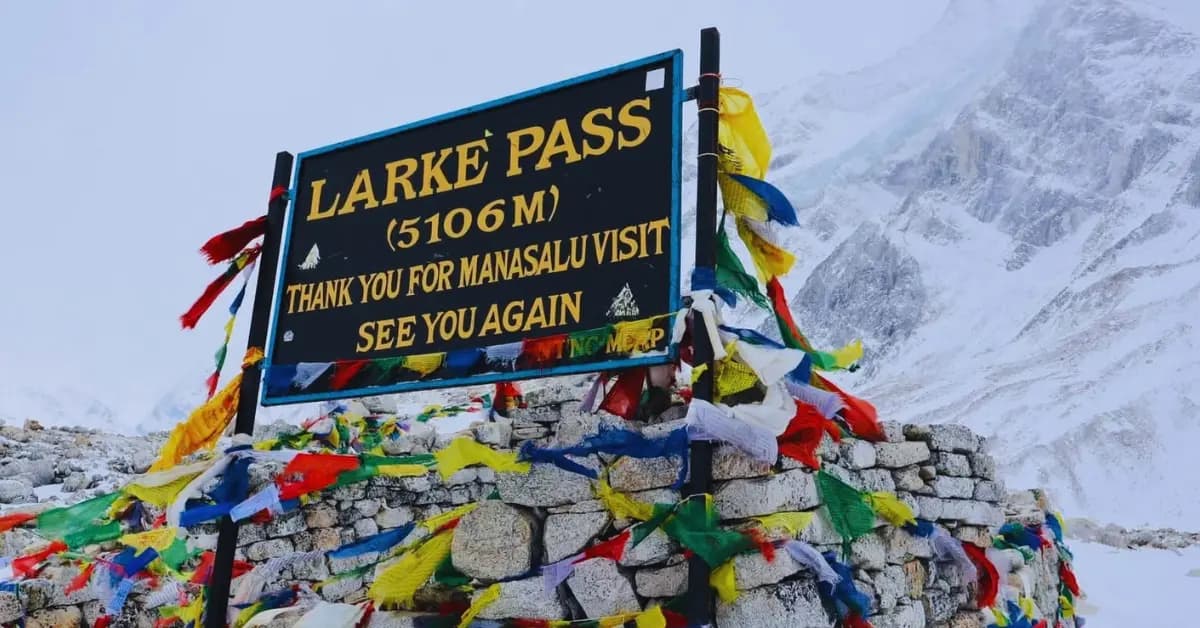
Larke Pass, also written as Larkya La, lies on the Manaslu Circuit between the Manaslu region and the lower areas toward Bimthang.
The route reaches the pass after gradually moving from lower valleys into a much higher and more alpine environment. The landscape changes significantly as the trail approaches the pass, with rocky terrain, high mountain surroundings, and fewer signs of permanent settlement.
After crossing, the trail descends toward Bimthang and eventually into a different landscape on the western side of the pass.
The crossing is therefore not an isolated attraction. It is the point where two very different parts of the Manaslu journey connect.
How Difficult Is Larke Pass?
Larke Pass is demanding primarily because of altitude, duration, and the conditions under which the crossing takes place.
The trail itself does not normally require technical climbing, but walking above 5,000 meters is very different from hiking at lower elevations.
The pace naturally becomes slower. Climbs that might feel minor elsewhere can require considerable effort, and stopping too frequently or trying to maintain a low-altitude walking pace can make the day unnecessarily difficult.
The pass day is also long. Trekkers need to be prepared not only for reaching the highest point but also for the descent that follows.
This is why we look at the entire journey to Larke Pass rather than judging the crossing by the final day's distance alone.
The Days Before the Crossing Matter Most
The morning of the pass crossing is not when altitude preparation begins.
By that point, the body should already have had time to adjust to increasing elevation.
The Manaslu Circuit provides a gradual progression through the mountains, but the itinerary still needs to be paced carefully. Moving too quickly through the higher villages to save a day can leave little room for adaptation.
Where trekkers sleep before the crossing is particularly important. The difference between a comfortable itinerary and an unnecessarily difficult one can come from how the overnight elevations are arranged.
For this reason, we consider altitude progression rather than simply counting trekking days when reviewing a Manaslu Circuit itinerary.
What Trekkers Often Underestimate
Fitness is useful, but it does not guarantee an easy crossing.
A trekker may be capable of walking for many hours at lower elevations and still experience a very different response above 4,000 meters.
At high altitude, reduced oxygen availability can affect pace, sleep, appetite, and recovery. The sensible approach is to listen to the body rather than trying to prove that the planned schedule can be completed at any cost.
The other commonly underestimated part is the descent.
Reaching the pass is a major milestone, but the day's walking continues. Tired legs, loose or uneven sections, and changing snow conditions can make the descent demanding in its own way.
Why an Early Start Is Important
The pass-crossing day normally begins early.
An early departure gives the group more time to make the ascent, reach the pass, and begin the descent while conditions are generally more favorable.
Mountain weather can change during the day, particularly at high elevations. Wind, cloud, snow, and reduced visibility can make an already demanding crossing considerably harder.
The exact start time depends on the season, overnight location, weather, trail conditions, and the pace of the group.
The important point is that the crossing should be planned around the mountain conditions, not simply around a fixed clock time.
What Is the Trail Like?
The approach to Larke Pass becomes increasingly barren and alpine as the elevation rises.
The terrain can include rocky sections, snow or ice depending on conditions, and uneven ground. There is no technical climbing involved in the normal trekking route, but the combination of terrain and altitude makes ordinary walking feel more demanding.
The high section is particularly exposed to weather.
A trail that feels straightforward in clear conditions can become much more difficult when snow covers landmarks or cloud reduces visibility.
This is why current trail conditions matter more than photographs from a previous season.
Weather Can Change the Crossing
Weather is one of the reasons a Larke Pass itinerary should have some flexibility.
Snowfall can affect the trail, while strong wind and poor visibility can make the crossing slower and more demanding.
A schedule with no margin can create unnecessary pressure if conditions change.
For an organized trek, we prefer to treat a high-pass crossing as something that needs to be earned by the conditions of the day, rather than something that must happen simply because it is written on the itinerary.
That does not mean changing plans unnecessarily. It means allowing enough room to make a sensible decision when the mountain does not cooperate.
Larke Pass Is Part of a Remote Manaslu Circuit Trek
One of the important differences between Larke Pass and a high pass on a more developed trekking route is the surrounding infrastructure.
The Manaslu region is considerably more remote than the busiest trekking corridors.
Accommodation and services are more limited in the higher sections, and there are fewer convenient alternatives if a group needs to change its plan.
This affects everyone on the trek, but particularly trip organizers.
A slower walking group, unexpected weather, illness, or a delayed start can have consequences beyond that single day because there may be limited options farther along the route.
This is why contingency planning matters more on the Manaslu Circuit.
What Happens After Crossing Larke Pass?
The descent toward Bimthang marks a noticeable change in the journey.
After the high and barren environment around the pass, the trail gradually moves toward lower elevations and a different landscape.
For many trekkers, this transition is one of the satisfying parts of the Manaslu Circuit. The pass is not simply a summit to reach and photograph; it connects two distinct sections of the trek.
By the time the group reaches the lower side, the physical challenge of the pass is behind them, but the journey through the Manaslu region continues.
When Is the Best Time to Cross?
Spring and autumn are generally the main trekking periods for the Manaslu Circuit, but the actual conditions at Larke Pass depend on weather and snow as well as the month.
The high section can experience significantly different conditions from the lower valleys.
This is why a trekking calendar should be used as a guide rather than a guarantee.
For anyone planning the crossing, recent information about snow, weather, and trail conditions is more useful than relying solely on what the route was like in a previous year.
Who Is Larke Pass Suitable For?
Larke Pass is better suited to trekkers who are prepared for a high-altitude and relatively remote mountain journey.
Previous high-altitude experience is helpful, although it is not the only factor that matters.
A sensible itinerary, gradual acclimatization, appropriate equipment, realistic walking expectations, and the ability to adapt to changing conditions are all important.
For groups, the slowest member's ability to handle the route needs to be considered when planning the crossing.
A high-pass trek should be challenging because of the mountain itself, not because the itinerary was made unnecessarily tight.
What to Consider Before Booking a Manaslu Trek
Before booking a route that crosses Larke Pass, look beyond the stated altitude.
Check:
- How the itinerary gains elevation
- Where the group sleeps before the crossing
- How long the pass day is expected to take
- What kind of accommodation is available
- What the route requires in terms of permits and guide arrangements
- How weather-related changes are handled
- Whether the itinerary has enough flexibility
These details can have a much greater effect on the experience than a simple statement that the pass is “challenging.”
Larke Pass Is a Test of Preparation as Much as Fitness
Larke Pass is a demanding crossing, but its difficulty should not be reduced to its 5,106-meter elevation.
The real challenge is the combination of altitude, terrain, weather, remoteness, and the length of the day.
Good Manaslu Circuit trek preparation makes those factors manageable. Poor planning can make an otherwise achievable crossing unnecessarily difficult.
For that reason, Larke Pass is best approached as part of the entire Manaslu Circuit. The success of the crossing depends not only on what happens at the pass, but on how well the trek has been planned in the days leading up to it.
About Author
Amir Adhikari is the Founder and Trip Curator of Everest Thrill Trek and Expedition. With 10+ years of experience in Nepal’s competitive tourism sector, he is a recognized expert in designing safe, personalized, and high-thrill Himalayan itineraries. His dedication to responsible travel and creating authentic experiences has positioned Everest Thrill as a leading specialist for Everest, Annapurna, and off-the-beaten-path adventures.